Odessa TX Foam Roofing Experts
Get high-performance spray foam and integrated roof systems in Odessa that manage climate conditions in a single system per IECC/IRC and IBC. Opt for open-cell to enhance vented attics and sound control, or closed-cell to maximize higher R-value, Class II vapor control, and rigidity. We protect per IECC R402.4 and validate with blower-door testing. Solar-resistant coatings protect SPF per ASTM and CRRC. Safe installs follow OSHA and IRC R316. Continue reading to explore options, ROI, and warranty details.
Main Highlights
- SPF delivers outstanding performance in Permian Basin extreme conditions, efficiently managing temperature, ventilation, and humidity while satisfying all IECC/IRC requirements for moisture management and air barriers.
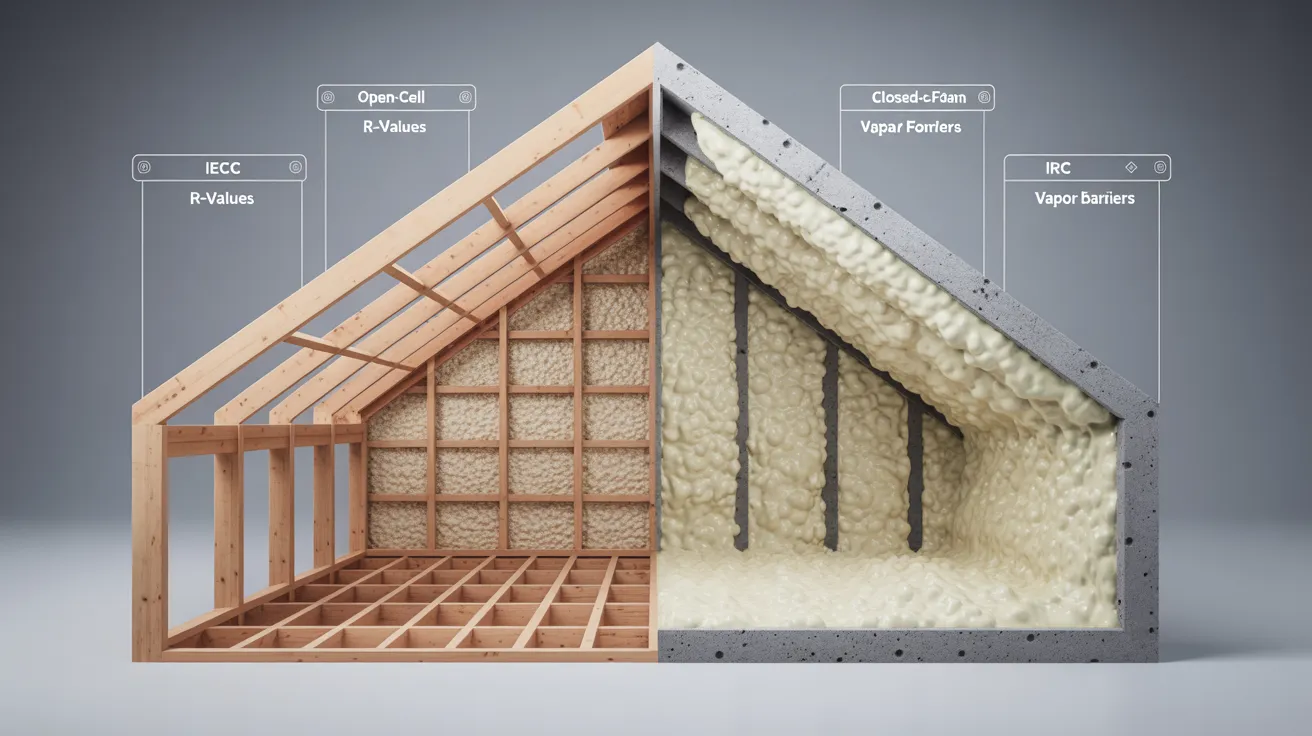
- Open-cell spray foam ventilates interior walls and attic spaces, while closed-cell offers higher R-value, increased structural rigidity, and functions as a Class II vapor retarder when installed to code thickness.
- Uniform SPF roofs with UV-resistant coatings reduce water infiltration, improve solar reflection, and satisfy IBC and ASTM standards.
- Our specialists comply with OSHA safety standards and implement correct containment methods, performing preliminary testing, monitoring equipment controls, and verifying insulation thickness and air barrier efficiency through detailed blower-door analysis.
- Look forward to reduced HVAC system usage and 3-7 year cost recovery; certified ACH50, R-values, and warranties support rebates and code compliance.
Understanding Spray Foam's Effectiveness in the Permian Basin
While West Texas faces extreme weather variations from triple-digit summers to cold snaps and dust-laden winds, spray polyurethane foam (SPF) maintains reliable performance because it regulates heat, air, and moisture in a single assembly. You obtain heat resilience from a continuous, air-impermeable layer that limits thermal and air gains following IECC and IRC N1102/IECC R402 air-sealing criteria. SPF additionally reduces moisture migration by keeping warm-side temperatures above dew point, conforming to IRC R701.3 vapor control intent and IBC 1403 weather protection.
Open-Cell or Closed-Cell: Selecting the Ideal Foam
When selecting an insulation foam, align its specifications to your building requirements, regulations, and cost considerations. ocSPF offers high vapor permeability and sound control, perfect for attic spaces and internal partitions. It generally offers R-3.6 to R-4 per inch, so determine application thickness to meet IECC/IRC R-values. Closed-cell (ccSPF) provides superior thermal resistance of R-6 to R-7 per inch, structural strength, and superior air barrier properties that minimizes thermal bridging. In West Texas's mixed-dry climate, ccSPF can act as a Class II vapor retarder at 1.5-2 inches; confirm dew-point control per IRC R702.7 and roof/wall assemblies.
You must manage thermal and ignition barriers per IRC R316 and ESR reports from manufacturers. Verify substrate moisture meets requirements, provide adequate ventilation throughout the installation process, and wear appropriate PPE to protect against isocyanate exposure.
Premium Roof Coatings for Waterproof Protection
It's possible to implement a seamless, monolithic membrane that eliminates seams and mechanical fasteners, minimizing water infiltration and complying with IBC performance standards for roof coverings. With sun-resistant waterproofing systems (such as acrylic, polyurethane, or silicone), you shield SPF from UV degradation and maintain reflectance per Energy Star and CRRC specifications where applicable. Adhere to manufacturer data sheets, ASTM classifications D6083/D6694, and OSHA fall-protection protocols during installation for safe, standards-compliant results.
Key Benefits of Monolithic Membranes
Once a roof coating hardens into a monolithic membrane, it gets rid of seams-the least resistant link in most assemblies-and forms a uninterrupted, watertight barrier that resists wind-driven rain and standing water. You get monolithic durability that reduces capillary intrusion at penetrations, junctions, and fasteners. By doing away with lap joints, you decrease failure points and meet IBC Section 1507 performance standards for roof coverings and IECC air-control objectives through seamless insulation continuity.
A monolithic system enhances uplift resistance when implemented following FM Global approvals and ANSI/SPRI standards, helping maintain attachment integrity in Odessa's wind events. This approach streamlines maintenance, because inspections concentrate on isolated punctures rather than miles of seams. Ensure you specify correct base preparation, moisture testing, and wet-mil verification to attain designed dry-film thickness, adhesion, and safe, code-compliant performance.
Ultraviolet-Resistant Waterproof Barriers
To extend a monolithic membrane's longevity, you need to specify UV-resistant waterproofing systems that don't degrade under Odessa's high-irradiance conditions. Specify elastomeric topcoats developed with UV stabilizers and reflective additives to attain cool-roof performance targets. Verify coatings conform to IRC/IBC energy provisions and ASHRAE 90.1 for solar reflectance and thermal emittance; check CRRC ratings to verify SRI. For spray polyurethane foam, install a compatible aliphatic polyurethane or silicone topcoat at the manufacturer's recommended dry film thickness, ensuring slope-to-drain.
Adhere to ASTM D6083 for acrylic guidelines, and conduct field adhesion testing following ASTM D4541. Ensure substrate moisture levels and ambient conditions as outlined in OSHA safety guidelines and SDS. Examine for pinholes, holidays, and edge terminations; fix promptly to maintain continuous, leak-free protection.
Air Sealing for Healthier, More Comfortable Spaces
Though frequently disregarded, comprehensive air sealing is essential to healthier, cozier buildings in Odessa's hot and gusty conditions. By regulating uncontrolled air leakage per IRC N1102/IECC requirements, you reduce airborne particles and external pollutants, protecting indoor air quality and occupant health. Spray foam insulation functions as both an air barrier and Class II vapor retarder when applied at code-specified thickness, limiting moisture-laden air movement that can drive condensation and mold.
You'll additionally minimize drafts and temperature variations by decreasing thermal bridging at building junction points, rim joists, and wall-roof connections. Conduct air infiltration testing (IECC R402.4) to verify airtightness targets and identify leakage pathways. Close gaps around HVAC components, lighting fixtures, and plumbing penetrations with appropriate fire-rated products when necessary (IRC R302). Consistently ensure ventilation per ASHRAE 62.2 for proper air exchange.
Cost Savings, Returns, and Utility Incentives
Cut down energy usage and regulate monthly costs by focusing on the biggest energy waste areas first: the building envelope and ductwork. Spray foam insulation decreases unwanted air flow as per IECC standards and effectively seal ducts according to IRC/IMC guidelines, creating reduced HVAC operation time and peak demand. You'll experience reduced seasonal costs as the foam barrier reduces hot season thermal transfer and cold weather heat loss, improving climate control.
Assess ROI by pairing reduced kWh/therms with Odessa utility rates. Standard simple payback falls between 3-7 years, with continuing payback continuing as energy prices rise. Verify R-values, ACH50 results, and duct leakage to outside (CFM25) to evaluate performance. Examine Oncor and local co-op rebate portals for efficiency rewards, weatherization funds, and demand-response bonuses. Log insulation certificates, combustion safety tests, and code compliance to meet eligibility.
Construction Projects and Retrofit Solutions
If you're working on a tight new build or upgrading an older home, spray foam adapts to different scenarios while maintaining its purpose: an effective solution for air sealing, insulation, and moisture management. In new construction, you can detail continuous insulation at the building envelope, coordinate air sealing with insulation, and meet IECC/IRC R-value or U-factor trade-offs. You'll incorporate temperature-controlled attics, sealed floor systems, and regulated ventilation rather than passive foundation vents, while pairing foam with moisture barriers when necessary.
When performing retrofits, you need to identify and fix existing gaps, confirm substrate dryness, and conduct combustion safety with CAZ testing. You'll properly seal crawlspaces, deactivate or block foundation vents according to code, and install mechanical ventilation to meet ASHRAE 62.2. Installing closed-cell foam delivers structural strength and flood resistance; meanwhile open-cell excels at sound control and vapor control.
Installation and Warranty Guide
Let's review our comprehensive installation plan: substrate inspection, humidity assessment, air flow configuration, and spray foam installation to achieve designated R-values according to IRC/IECC and manufacturer data sheets. We organize the jobsite with containment, PPE, fire safety checks, and ventilation to meet OSHA/NIOSH guidance and local fire-code specifications. We'll detail warranty coverage choices, including material and workmanship terms, what's protected (bonding, density, R-value), limitations, and paperwork required for claims.
Step-By-Step Guide
Prior to applying even an inch of foam in your Odessa home, we check safety, scope, and substrates per IRC/IBC and manufacturer specifications, then guide you through the plan and warranty terms. We confirm substrate adhesion, moisture, and temperature targets, record R-value goals per IECC, and determine closed- or open-cell according to application.
We begin by carrying out calibration of equipment and foam mixing based on manufacturer guidelines. We track pressure and hose temperatures, and carry out an initial spray test to assess lift height and reactivity. We proceed to apply with measured applications, following proper ventilation and safety barriers according to IRC R316. We check thickness using depth meters, properly seal transitional areas, and thoroughly document the installation.
Finally, we complete complete cure inspections, offer a written workmanship guarantee, and record product warranties with serial numbers and batch information.
Jobsite Preparation and Safety
Although every home is different, our crews follow standardized jobsite setup guidelines in compliance with OSHA 29 CFR 1926 and manufacturer requirements: we set up contained work spaces using poly containment, establish negative air meeting ASHRAE 62.2 targets, and post access control with PPE specifications (full-face respirators, gloves, Tyvek). We utilize lockout/tagout protocols for HVAC and electrical as applicable, and we ensure make-up air to eliminate combustion appliance backdrafting per IRC M1503. We place Class ABC extinguishers, examine SDS sheets, and carry out hazard communication briefings under 29 CFR 1910.1200. To ensure site safety, we safeguard adjacent finishes, shield ignition sources, and utilize intrinsically safe lighting. We track VOCs and isocyanate exposure, maintain egress routes, and document daily JHAs. Following curing, we air out, remove containment, and perform a final safety assessment.
Warranty Protection Plans
Although performance starts with appropriate setup and installation, your security is enhanced by multi-level warranties designed for Odessa's weather conditions and regulations. You receive a material warranty from the manufacturer and a workmanship guarantee from the contractor, both meeting IRC/IBC and IECC requirements for spray foam, fire barriers, and roofing systems. Extended warranties are available when you pair SPF with certified protective layers and maintain yearly checkups.
Protection encompasses important SPF specifications like moisture protection, density specifications, adhesion strength, and R-value maintenance, assuming correct vapor barriers and ventilation standards are followed. We maintain detailed records of surface moisture measurements, application layer depths, and curing conditions to preserve claim qualification. Coverage transfer options allow benefits to continue to the next owner with documented upkeep history. Optional riders covering hail damage and UV deterioration may be included. Warranty restrictions include improper use, unapproved alterations, and maintenance deferrals.
Frequently Asked Questions
Are Financing Options and Payment Plans Available for Insulation Projects?
Yes, you have access to structured payment options and flexible financing. We provide choices including 0% same-as-cash promotions, deferred payment options, and low-APR financing, subject to credit approval. Payment disbursement occurs by project milestones (setup, installation, final verification) and align with code-compliant scope per IRC/IECC R-values and fire safety (NFPA 286/ASTM E84). We'll provide an itemized cost analysis, lien notices, and warranty terms. Submit your application online or in person; your pre-qualification won't affect project scheduling.
Are Your Service Technicians Certified and Background Screened for In-Person Work?
You're protected by carefully screened specialists. Picture a carefully managed worksite where all equipment functions optimally; you proceed with assurance because each technician completes thorough criminal history checks and possesses professional certifications. They fulfill OSHA 10/30 safety requirements, comply with EPA RRP and ICC/IRC insulation regulations, and maintain NFPA 286/285 fire-testing protocols for assemblies. You receive credentialed teams, validated certifications, and management sign-offs, guaranteeing correct applications, clean clearances, and sealed efficiency with verifiable documentation.
How Soon Can We Schedule Your On-Site Assessment in Odessa?
We can schedule your on-site assessment as soon as today, subject to current day openings, or in 24-48 hours. We also offer weekend assessments. We'll conduct a Level 1 pre-screen per IRC R316 and OSHA 29 CFR 1910.134, checking ventilation, ignition sources, and access. We'll assess substrate moisture (≤19%), ambient temp/humidity, and roof load limits. We'll provide you with a detailed plan, safety plan, and permit guidance. Call now to lock in your time.
What Brands and Chemical Formulations of Foam Do You Use?
Similar to a well-tuned engine, you can expect consistent performance from our specified brands and formulations. You'll choose certified polyurethane blends from Huntsman/Demilec, Carlisle, and ICP. We apply closed cell chemistries (2 lb, HFO-blown, Class II vapor retarder) and open-cell systems, all ICC-ES evaluated (ESR- reports) and adhering to IRC/IBC, NFPA 286, and ASTM E84. You get proper ignition/thermal barriers per code, manufacturer-specified lift thickness, substrate temps, and safety equipment-guided safety during application and cure.
Will You Take Care of HOA Guidelines and Required Permits?
Indeed. You'll get dedicated HOA liaisons to analyze CC&Rs, process architectural review packets, and follow approvals. We manage permit management comprehensively: property layouts, product data sheets, ICC-ES reports, and energy efficiency requirements per IRC/IECC. We schedule inspections, ensure OSHA-compliant jobsite practices, and verify NFPA 285/UL listings where applicable. You'll get stamped drawings if required, plus written scope, ventilation plans, and disposal manifests, ensuring full jurisdictional compliance and a proper closeout.
In Summary
You're not pursuing fantasies-you're crafting comfort. In Odessa's climate, SPF satisfies IECC/IRC R-values and ASHRAE 90.1 standards, while continuous roof coatings provide Title 24-grade reflection and ASTM D6083 durability. You'll secure enhanced air barriers per ASTM E2178/E2357, Class A options per ASTM E84, and vapor control to IRC R702.7. We adhere to OSHA 1910/1926 PPE and ventilation protocols, then guarantee implementations with certified warranties. Prepared to achieve economic benefits, comfort, and code click here compliance-without leaks or uncertainty?